What Is Preventive Care in Health Insurance?

What’s Covered, What May Cost You & What You Need to Know
By Nicole Carson
Licensed Health Insurance Advisor
Quick Answer
Preventive care is healthcare designed to help prevent illness or identify certain health concerns early—often before you have symptoms.
Under certain health plans, eligible preventive services may be covered without a deductible, copay, or coinsurance when applicable requirements are met.
But there’s an important distinction:
A preventive appointment does not necessarily mean everything that happens during that appointment will be considered preventive care.
The service you receive, why you receive it, your provider's network status, and the type of health coverage you have can all affect what you ultimately pay.
Health insurance can be confusing enough without receiving a medical bill you weren't expecting.
One of the most common examples?
You schedule your annual physical because you've been told preventive care is covered.
You go to your appointment, have your exam, maybe discuss a concern with your doctor—and then a few weeks later...
You get a bill.
So what happened?
The answer usually comes down to understanding what health insurance actually considers preventive care and how preventive services can differ from diagnostic care.
Let's break it down in plain English.

What You’ll Learn
By the end of this guide, you'll understand:
What preventive care means
Common examples of preventive services
How preventive care benefits can work
Why you might receive a bill after an annual physical
Preventive care vs. diagnostic care
Whether your deductible applies
Why not every health plan handles preventive care the same way
What to check before your next appointment
What Is Preventive Care?
Preventive care generally refers to healthcare intended to prevent certain illnesses or identify potential health concerns before symptoms develop.
Instead of waiting until something is wrong, preventive healthcare focuses on staying ahead of potential problems.
For example, your healthcare provider might recommend certain screenings based on your age or other factors even though you're feeling perfectly healthy.
Preventive care can help:
Identify certain health risks
Detect some conditions earlier
Keep recommended vaccinations current
Monitor certain health indicators
Establish a baseline for your health
Give you an opportunity to discuss appropriate screenings with your healthcare provider
What qualifies as preventive care can depend on factors including your age, sex, risk factors, reason for receiving the service, and specific health plan.
What Are Common Examples of Preventive Care?
Preventive services can vary depending on the individual and their health coverage, but examples may include:
Annual Wellness Visits
Routine preventive exams can give you and your healthcare provider an opportunity to review your general health and discuss appropriate preventive services.
Vaccinations
Certain recommended immunizations may qualify as preventive services.
Routine Screenings
Depending on applicable recommendations and your plan, these may include certain:
Blood pressure screenings
Cholesterol screenings
Diabetes screenings
Mammograms
Cervical cancer screenings
Colorectal cancer screenings
Preventive Care for Children
Certain well-child visits, developmental screenings, immunizations, and other recommended services may qualify as preventive care.
Preventive Care for Women
Certain screenings, counseling services, and other preventive services may also qualify depending on eligibility and plan requirements.
🌻 Important: A service appearing on this list does not guarantee that it will be covered without cost-sharing under every health plan.
Your specific plan matters.
Is Preventive Care Free?
This is where the terminology can get misleading.
You may hear:
“Preventive care is free.”
A better way to understand it is:
Certain eligible preventive services may be covered without cost-sharing under qualifying health plans when applicable requirements are met.
That could mean you don't have to pay a deductible, copay, or coinsurance for a particular eligible preventive service.
However, several things can affect your cost, including:
Whether your provider is in-network
Whether the service qualifies as preventive
Why the service is being performed
Whether additional services are provided
Your particular health plan and benefit structure
And remember: you're still paying your monthly health insurance premium regardless of whether a particular preventive service has additional cost-sharing.
Preventive Care vs. Diagnostic Care
This is one of the most important differences to understand.

Here's where it gets interesting:
The same type of medical test can sometimes be treated differently depending on why it was ordered.
A screening performed routinely when you have no symptoms may be considered preventive under your plan.
Testing performed because you're experiencing symptoms may instead be considered diagnostic.
That's why the reason for the service can matter just as much as the service itself.
Why Did I Get a Bill After My Annual Physical?
Let's look at a simple example.
You schedule your annual preventive exam.
During the visit, your provider performs the expected preventive services.
Then you mention:
“I've been having shoulder pain for the past few weeks.”
Your provider evaluates your shoulder and perhaps orders an X-ray.
Now there may be two different things happening during the same appointment:
Preventive care: Your routine wellness examination.
Problem-focused/diagnostic care: Evaluating your shoulder pain.
Depending on your plan and how those services are billed and processed, the additional evaluation or testing may be subject to your:
Deductible
Copay
Coinsurance
Other applicable cost-sharing
The takeaway:
Preventive appointment ≠ everything performed during the appointment is automatically preventive.
That's one of the easiest ways someone can receive a bill they weren't expecting.
Does Your Deductible Apply to Preventive Care?
Not always.
Certain eligible preventive services under qualifying health plans may be covered before you've met your deductible.
For example, imagine your health plan has a:
$5,000 deductible
You haven't spent anything toward it yet this year.
That doesn't necessarily mean you have to spend $5,000 before receiving eligible preventive services.
Certain preventive benefits may be available without first meeting that deductible.
However, additional services provided during the appointment may be treated differently.
And importantly, not every type of health coverage follows the same benefit structure.
Do All Health Insurance Plans Handle Preventive Care the Same Way?
No.
This is especially important when comparing health coverage.
ACA-compliant individual and small-group health plans have specific preventive-service requirements, while other forms of health coverage can operate under different benefit structures.
For example, fixed indemnity coverage works differently from traditional major medical health insurance.
Rather than assuming every plan uses the same:
Deductibles
Copays
Coinsurance
Preventive-care benefits
you need to understand how the specific policy you're considering actually pays benefits.
We'll cover fixed indemnity coverage separately in an upcoming BrightBloom Learning Center article because it deserves a full explanation of its own.
A Real-World Example
Let's compare two situations.
Scenario 1: Routine Preventive Visit
You schedule an annual wellness visit.
You're not experiencing any new symptoms, and the visit includes eligible preventive services according to your plan.
Those qualifying services may be covered without additional cost-sharing.
Scenario 2: Preventive Visit + New Concern
You schedule the same annual wellness visit.
During the appointment, you tell your provider about recurring stomach pain.
Your provider evaluates the problem and orders additional testing.
The preventive portion of your appointment may still be treated as preventive, while the additional evaluation or testing may be processed under your plan's regular medical benefits.
Same appointment. Different types of care. Potentially different costs.

Common Preventive Care Mistakes
Mistake #1: Assuming Everything During an Annual Physical Is Free
A preventive appointment doesn't automatically make every service performed during that appointment preventive.
Mistake #2: Forgetting About the Provider Network
Your plan's network requirements can still matter when receiving preventive services.
Mistake #3: Assuming Every Screening Is Preventive
Why the screening was ordered, your eligibility, frequency requirements, and plan rules can affect coverage.
Mistake #4: Assuming Every Health Plan Works the Same Way
Different types of health coverage can structure benefits very differently.
Mistake #5: Waiting Until After the Appointment to Check Your Benefits
Understanding your coverage beforehand gives you the opportunity to ask questions before services are performed.
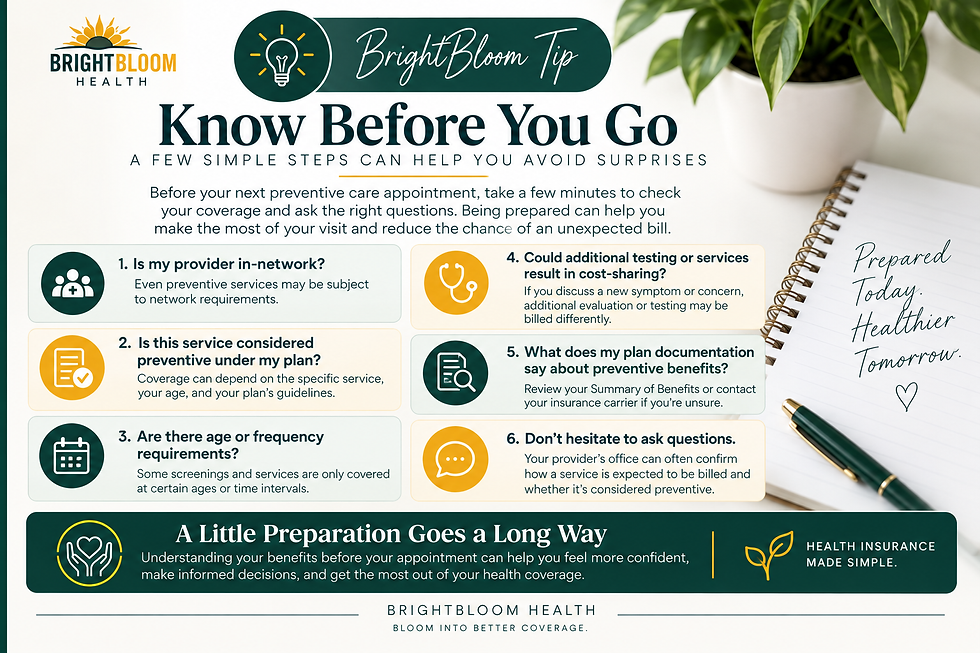
🌻 BrightBloom Tip
Know Before You Go
Before your next preventive appointment, take a few minutes to check:
✓ Is my provider in-network?
✓ Is this particular service considered preventive under my plan?
✓ Are there age or frequency requirements?
✓ Could additional testing or services result in cost-sharing?
✓ What does my plan documentation say about preventive benefits?
A little preparation before your appointment can help you better understand what to expect afterward.
Frequently Asked Questions
Is an annual physical considered preventive care?
It often can be, depending on the type of visit and your health plan. Additional services or evaluation of medical concerns during the appointment may be treated differently.
Do I have to meet my deductible before preventive care is covered?
Not necessarily. Certain eligible preventive services under qualifying plans may be covered without first meeting your deductible.
Why did I receive a bill for a preventive visit?
Possible reasons include additional non-preventive services, diagnostic testing, network status, frequency or eligibility requirements, or how services were billed and processed under your particular plan.
Are preventive services always covered at 100%?
No. Coverage depends on the service, your health plan, eligibility requirements, network rules, and other applicable terms.
Is preventive care the same on every health insurance plan?
No. Different types of health coverage can have different benefit structures and preventive-care provisions.
Final Thoughts
Preventive care can be an incredibly valuable part of your health coverage—but understanding what “preventive” actually means is important.
Don't automatically assume:
Annual physical = everything is free.
Instead, understand the service you're receiving, why you're receiving it, whether your provider is in-network, and how your particular health plan handles preventive benefits.
The more you understand your coverage before you need to use it, the fewer surprises you're likely to encounter later.
At BrightBloom Health, my goal isn't simply to help you find health coverage. It's to help you understand what you're choosing and how your benefits work so you can make informed decisions with confidence.
🌻 Better Coverage. Brighter Future.

Continue Learning
If you're building your health insurance knowledge, continue with:
What Is a Health Insurance Deductible? Learn what you pay before your insurance begins sharing more of certain covered costs.
What Is Coinsurance? Understand how percentage-based cost-sharing works.
What Is an Out-of-Pocket Maximum? Learn about the annual limit on certain covered healthcare expenses.
What Is a copay? Learn what exactly a copay.
What Is the difference between a PPO and HMO? Understand the difference between these two networks.
Coming Soon: What Is a Fixed Indemnity Health Plan?We'll break down how fixed indemnity coverage works and how it differs from traditional major medical insurance.
About the Author
Nicole Carson is a Licensed Health Insurance Advisor with BrightBloom Health, helping individuals, families, self-employed professionals, and small businesses understand their health coverage options and make informed decisions about their benefits.
This article is for general educational purposes only and is not a guarantee of benefits or coverage. Health insurance benefits, limitations, exclusions, network requirements, and cost-sharing vary by plan. Always review your specific policy documents and plan benefits for details.



Comments