What Is Coinsurance in Health Insurance? How It Works and What You Pay

🌻 Bright Bloom Health
By Nicole Carson | Licensed Health Insurance Advisor
📖 11 Minute Read
Quick Answer
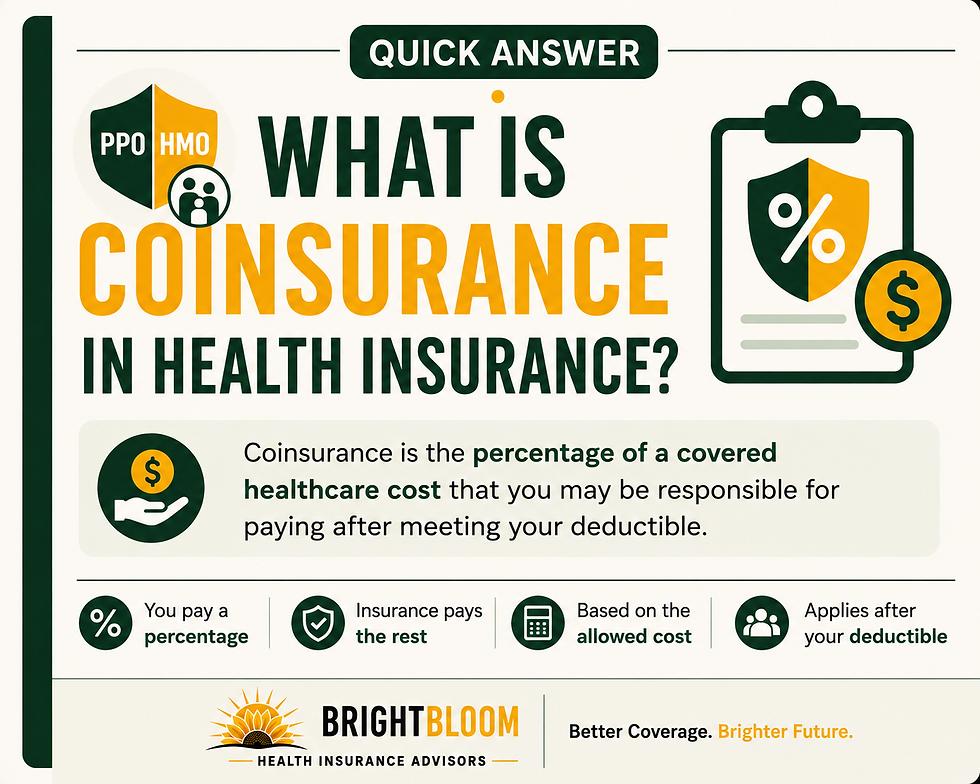
Coinsurance is the percentage of a covered healthcare cost that you may be responsible for paying after meeting your deductible.
For example, if your health insurance plan has 20% coinsurance, you may pay 20% of the plan's allowed cost for a covered service while your insurance company pays the remaining 80%.
Coinsurance is different from a copay because a copay is typically a fixed dollar amount, while coinsurance is a percentage of the cost.
Exactly when coinsurance applies depends on the terms of your specific health insurance plan.
Health insurance has its own vocabulary, and coinsurance is one of the terms that causes the most confusion.
You may see a plan that says:
$2,500 deductible
$30 primary care copay
20% coinsurance
$7,500 out-of-pocket maximum
But what does the 20% actually mean?
More importantly, how much could you actually have to pay?
Understanding coinsurance is important because it can significantly affect your healthcare costs, particularly if you need imaging, outpatient procedures, hospital care, surgery, specialist treatment, or other higher-cost medical services.
At Bright Bloom Health, we help individuals, families, self-employed professionals, and small businesses understand how health insurance plans work beyond simply looking at the monthly premium.
Here's what you need to know about coinsurance before choosing a health insurance plan.
What Is Coinsurance in Health Insurance?
Coinsurance is a form of cost-sharing between you and your health insurance company.
Instead of paying a fixed amount for a healthcare service, you pay a percentage of the plan's allowed cost.
For example, suppose your plan states:
20% coinsurance after deductible
Once the applicable deductible has been satisfied, you may be responsible for 20% of the allowed cost of a covered service while the insurance company pays the remaining 80%.
This is sometimes described as an 80/20 plan.
However, coinsurance percentages can vary considerably between health insurance plans.
You might see:
10% coinsurance
20% coinsurance
30% coinsurance
40% coinsurance
50% coinsurance
Generally, the lower your coinsurance percentage, the smaller your share of an applicable covered expense will be.
But coinsurance is only one part of the plan's overall cost structure.
A plan with 10% coinsurance is not automatically better than a plan with 20% coinsurance. You also need to consider the deductible, copays, provider network, prescription benefits, out-of-pocket maximum, premiums, and the services to which coinsurance applies.
How Does Coinsurance Work?
Let's use a simple example.
Suppose you have a health insurance plan with:
$2,000 deductible
20% coinsurance after the deductible
$7,500 out-of-pocket maximum
You have already satisfied your $2,000 deductible for the year.
Later, you receive a covered medical service for which your health plan's allowed amount is $1,000.
If 20% coinsurance applies:
You pay:
20% of $1,000 = $200
Your insurance plan pays:
80% of $1,000 = $800
That $200 is your coinsurance responsibility.
The important phrase here is allowed amount.
Your coinsurance generally isn't simply calculated from whatever amount appears on the provider's original bill. The calculation is typically based on the amount recognized under your plan for the covered service, subject to the plan's terms and network rules.
That distinction can make a substantial difference.
What Does "20% Coinsurance After Deductible" Mean?
This phrase appears frequently in health insurance documents.
Let's break it down.
"20% coinsurance"
You are responsible for 20% of the applicable allowed cost.
"After deductible"
The coinsurance generally begins after you've satisfied the applicable deductible.
Suppose your plan has a $3,000 deductible and you haven't paid anything toward it yet.
You receive a covered service with an allowed amount of $1,000 that is subject to the deductible.
You may have to pay that $1,000 toward your deductible rather than simply paying 20%.
If you've already met your deductible, the plan's coinsurance provision may then apply.
This is why looking at a coinsurance percentage by itself doesn't tell you enough about what a plan will actually cost you.
Deductible vs. Coinsurance: What's the Difference?
Your deductible and coinsurance are related, but they are not the same thing.
A deductible is generally an amount you must pay toward certain covered healthcare services before your insurance begins sharing those costs according to the plan.
Coinsurance is the percentage of applicable costs you pay when the plan begins sharing the expense.
Here's a simplified example:
Your plan has:
$2,500 deductible + 20% coinsurance
You receive medical care subject to the deductible.
Stage 1: Deductible
You pay eligible costs toward your $2,500 deductible.
Stage 2: Coinsurance
After satisfying the deductible, you may pay 20% of additional covered allowed costs while your insurance pays 80%.
Stage 3: Out-of-Pocket Maximum
If your eligible in-network spending reaches your plan's annual out-of-pocket maximum, the plan generally pays 100% of covered in-network benefits for the remainder of that plan year, subject to the plan's terms.
Think of these as different pieces of the same cost-sharing system.
INTERNAL LINK: What Is a Health Insurance Deductible?
Coinsurance vs. Copay: What's the Difference?
Another common source of confusion is the difference between a copay and coinsurance.
The easiest way to remember it is:
Copay = fixed dollar amount
Coinsurance = percentage
For example:
Your health insurance plan might charge:
$30 primary care copay
$60 specialist copay
$75 urgent care copay
20% coinsurance for outpatient surgery
The first three are predetermined dollar amounts.
The surgery cost is based on a percentage.
If the applicable allowed amount for the surgery were $5,000 and your responsibility were 20%, your coinsurance would be:
$1,000
That's very different from paying a $30 or $60 copay.
Some plans use mostly copays.
Others rely more heavily on deductibles and coinsurance.
Many use a combination.
INTERNAL LINK: What Is a Health Insurance Copay?
Deductible vs. Copay vs. Coinsurance
These three terms work together, but they describe different ways you may share healthcare expenses with your insurance company.
Deductible: An amount you may need to pay toward certain covered services before the plan begins sharing those costs.
Copay: A fixed dollar amount you pay for certain covered services.
Coinsurance: A percentage of the allowed cost you're responsible for paying for certain covered services.
Here's an example of how all three might appear within one plan:
Healthcare Service | Your Cost |
Primary care visit | $30 copay |
Specialist visit | $60 copay |
Lab work | Subject to deductible |
MRI | 20% coinsurance after deductible |
Hospital stay | 20% coinsurance after deductible |
This is one reason you should never judge a health insurance plan based on one number alone.
Two plans with the exact same monthly premium can expose you to very different healthcare costs depending on how their benefits are structured.
What Healthcare Services Usually Have Coinsurance?
This varies by plan, but coinsurance may apply to services such as:
Diagnostic imaging
MRIs
CT scans
Outpatient procedures
Hospitalizations
Emergency room care
Surgery
Specialist procedures
Lab work
Durable medical equipment
Certain prescription medications
Physical therapy
Infusion therapy
Other advanced medical services
However, you should never assume a service will be subject to coinsurance simply because another health plan handles it that way.
One plan may charge a copay for a service while another applies the deductible and coinsurance.
Always review the plan's Summary of Benefits and Coverage (SBC) and other plan documents.
What Does 0% Coinsurance Mean?
If your plan lists 0% coinsurance for a covered service, that generally means you don't owe a percentage of the allowed cost for that service once any applicable requirements have been satisfied.
However, that does not necessarily mean the service is completely free in every circumstance.
The service might still be:
Subject to a deductible
Limited to certain providers
Subject to prior authorization
Covered only when medically necessary
Restricted by other plan provisions
For example, a plan could say:
0% coinsurance after deductible
That is different from:
$0, deductible does not apply
Reading the full benefit language matters.
What Is 30% Coinsurance?
Thirty percent coinsurance generally means you are responsible for 30% of the applicable allowed amount, while your insurer pays 70%, once the relevant plan requirements have been met.
For example:
Allowed cost: $4,000
Your coinsurance: 30%
Your portion:
$1,200
Insurance portion:
$2,800
Compare that with a plan with 10% coinsurance:
10% of $4,000 = $400
That's an $800 difference on just one service.
This demonstrates why coinsurance can become especially important for people who expect to use significant healthcare services during the year.
How Coinsurance Can Affect a Large Medical Bill
Coinsurance may not seem significant when you're looking at percentages on a plan comparison.
But percentages become meaningful very quickly when the underlying medical expense is large.
Suppose an applicable covered hospital service has an allowed cost of:
$20,000
If your deductible has already been met:
10% coinsurance
Your share could be approximately $2,000.
20% coinsurance
Your share could be approximately $4,000.
30% coinsurance
Your share could be approximately $6,000.
Your actual responsibility will depend on the plan's terms, your remaining out-of-pocket maximum, network status, and other factors.
This is why comparing health insurance plans requires more than asking:
"What's the monthly premium?"
You need to understand your potential financial exposure if you actually have to use the insurance.
How Does Coinsurance Work With Your Out-of-Pocket Maximum?
Your out-of-pocket maximum is another critical number to understand.
Generally, eligible amounts you pay for covered in-network services—such as applicable deductibles, copays, and coinsurance—count toward your annual out-of-pocket maximum.
Once you reach that limit, the insurance plan generally pays 100% of covered in-network benefits for the rest of the plan year.
For example:
Your plan has a:
$2,500 deductible
20% coinsurance
$7,500 out-of-pocket maximum
You experience a year with substantial healthcare needs.
Between your deductible, copays, and coinsurance, your eligible spending eventually reaches $7,500.
At that point, your plan generally covers 100% of additional covered in-network benefits for the remainder of the plan year.
However, not every expense necessarily counts toward your out-of-pocket maximum.
For example, monthly insurance premiums generally do not count.
Out-of-network charges and non-covered services may also be treated differently depending on the plan.
Does Coinsurance Apply to Prescriptions?
It can.
Prescription benefits vary significantly by health insurance plan.
Some plans use fixed copays, such as:
$10 generic prescriptions
$40 preferred brand medications
$75 non-preferred brand medications
Other plans may charge coinsurance for certain medication tiers.
For example:
Specialty medication: 30% coinsurance
If the plan's applicable cost for that medication is $2,000, a 30% coinsurance responsibility could equal $600, subject to the plan's specific rules and limits.
If you regularly take medications—particularly expensive brand-name or specialty prescriptions—reviewing the plan's formulary and prescription cost-sharing can be extremely important.
In-Network vs. Out-of-Network Coinsurance
Your coinsurance may change depending on whether you receive care in-network or out-of-network.
For example, a PPO plan might state:
In-network: 20% coinsurance
Out-of-network: 40% coinsurance
At first glance, you might assume going out-of-network simply doubles your percentage.
But out-of-network care can be more complicated.
The provider may charge more than the amount your insurance company recognizes, and depending on the circumstances and applicable protections, you could potentially be responsible for additional amounts.
That's why provider network access matters just as much as the percentage printed next to "coinsurance."
Common Coinsurance Mistakes
Understanding coinsurance before enrolling can help you avoid unpleasant surprises later.
Mistake #1: Assuming 20% Coinsurance Means Insurance Only Pays 20%
This is one of the most common misunderstandings.
If the benefit states that your coinsurance is 20%, that generally means you pay 20% and the insurer pays the remaining covered portion, subject to the plan.
Mistake #2: Ignoring the Deductible
Seeing "20% coinsurance" doesn't necessarily mean you'll immediately pay only 20% for a service.
The deductible may need to be satisfied first.
Mistake #3: Comparing Only Monthly Premiums
A cheaper monthly premium does not automatically mean a cheaper health plan overall.
The plan could have a higher deductible, higher coinsurance, or a higher out-of-pocket maximum.
Mistake #4: Assuming Every Service Uses the Same Coinsurance
Your plan may have different cost-sharing arrangements for different services.
Mistake #5: Not Checking the Provider Network
A low coinsurance percentage isn't particularly helpful if the doctors or hospitals you want to use aren't participating in the plan's network.
Mistake #6: Confusing Coinsurance With a Copay
Remember:
Copay = dollar amount
Coinsurance = percentage

Is Lower Coinsurance Always Better?
Not necessarily.
Suppose you're comparing two plans.
Plan A
Lower monthly premium
$3,000 deductible
20% coinsurance
$7,500 out-of-pocket maximum
Plan B
Higher monthly premium
$1,500 deductible
10% coinsurance
$5,000 out-of-pocket maximum
Plan B appears stronger from a cost-sharing perspective.
But if you rarely use healthcare services, the additional premium you pay throughout the year may outweigh the savings you receive from its lower deductible and coinsurance.
On the other hand, someone who expects surgery, frequent specialist visits, expensive imaging, or other substantial healthcare needs may value the lower cost-sharing.
There isn't one health insurance plan that's automatically best for everyone.
The goal is to find the plan whose overall structure fits how you expect to use your coverage.
Which Coinsurance Level Is Best for Families?
Families should consider more than just the coinsurance percentage.
Think about:
How often family members visit doctors
Whether anyone regularly sees specialists
Ongoing medical conditions
Prescription medications
Planned procedures
Preferred doctors and hospitals
Children's healthcare needs
The family deductible
Individual vs. family out-of-pocket maximums
Monthly budget
A family that expects significant medical care may prefer a plan with stronger cost-sharing benefits even if the monthly premium is higher.
A generally healthy family that rarely uses healthcare services may prioritize premiums differently.
The key is evaluating both predictable monthly costs and potential healthcare expenses.
What Should Self-Employed Individuals Consider?
Health insurance can be especially important for self-employed professionals because you don't have an employer selecting or subsidizing a traditional group plan on your behalf.
When comparing coverage, don't stop at the monthly premium.
Consider:
Deductible
Coinsurance
Copays
Out-of-pocket maximum
Provider network
Prescription coverage
Travel needs
Expected healthcare use
Overall annual financial exposure
A plan that looks inexpensive each month could potentially cost significantly more if you require substantial medical care.
Likewise, paying substantially more every month for richer benefits may not make sense for everyone.
The best approach is to compare the entire plan, not one feature.
Bright Bloom Health Tip
When comparing health insurance plans, ask yourself:
"What would this plan cost me in a bad healthcare year—not just a healthy year?"
Looking at your premium tells you what you know you'll spend.
Looking at your deductible, coinsurance, copays, and out-of-pocket maximum helps you understand what you could spend if something unexpected happens.
Before choosing a plan, compare:
Monthly premium
Annual deductible
Copays
Coinsurance
Out-of-pocket maximum
Provider network
Prescription coverage
Expected healthcare needs
The best health insurance plan isn't necessarily the one with the lowest premium or the lowest coinsurance. It's the one that provides the right balance of coverage, access, and cost for your situation.

Frequently Asked Questions About Coinsurance
What does 20% coinsurance mean?
Twenty percent coinsurance generally means you pay 20% of the applicable allowed cost of a covered healthcare service while your insurance plan pays the remaining covered portion, after any applicable deductible or other requirements have been satisfied.
Is coinsurance paid before or after the deductible?
Many plans apply coinsurance after the applicable deductible has been met. However, benefit structures vary, so review your specific plan documents.
Is 0% coinsurance good?
It can reduce your share of certain covered healthcare expenses, but you should determine whether a deductible or other requirements apply before the 0% coinsurance takes effect.
What's better: a copay or coinsurance?
Neither is automatically better. A copay provides a predictable fixed cost, while coinsurance depends on the cost of the service. The overall plan design is more important than either feature alone.
Does coinsurance count toward my out-of-pocket maximum?
Eligible coinsurance payments for covered in-network services generally count toward the plan's out-of-pocket maximum. Check your plan documents for the specific rules.
Do I still pay coinsurance after reaching my out-of-pocket maximum?
For covered in-network benefits, the plan generally pays 100% after you've reached the applicable annual out-of-pocket maximum. Certain expenses may not count toward or be subject to that limit.
Why do some plans have higher coinsurance than others?
Health insurance plans distribute costs differently. A plan may trade lower monthly premiums for a higher deductible or coinsurance, while another may charge higher premiums in exchange for lower cost-sharing.
Is 20% coinsurance expensive?
It depends on the healthcare service.
Twenty percent of a $100 allowed charge is $20.
Twenty percent of a $10,000 allowed charge is $2,000.
That's why coinsurance becomes particularly important when evaluating coverage for potentially expensive healthcare services.
Let Bright Bloom Health Help You Compare Coverage
Understanding coinsurance, deductibles, copays, provider networks, and out-of-pocket maximums can make comparing health insurance plans feel complicated.
But choosing coverage shouldn't come down to guessing which set of numbers looks best.
At Bright Bloom Health, we help individuals, families, self-employed professionals, and small businesses compare health insurance options based on their healthcare needs, preferred providers, budget, and overall coverage goals.
Whether you're purchasing health insurance for the first time, reviewing your current coverage, becoming self-employed, changing jobs, or exploring options for your family or business, we'll help you understand how the coverage actually works before you make a decision.
Let Bright Bloom Health help you find coverage designed around your needs—not simply the lowest number on the screen.
Better Coverage. Brighter Future.


Comments